Why Vastu for Factories Matters for Productivity and Smooth Operations
Vastu for factories is becoming an important factor for improving productivity, reducing machine breakdowns, and ensuring smooth operations in manufacturing units.
If you’ve ever walked into a factory that just feels right, where work moves smoothly, the workers seem settled, and the machines rarely give trouble, there’s a good chance someone paid attention to more than just the equipment. A lot of factory owners are now looking at Industrial Vastu as part of that equation, and what they find often surprises them.
At Geosols Vastu Consulting, we’ve visited enough manufacturing units across North India to know that two factories with similar setups can produce very different results. One runs like clockwork. The other keeps hitting walls, whether it’s repeated machine breakdowns, high worker turnover, or orders that drag on without reason. The difference isn’t always visible on paper, and that’s exactly where Vastu comes in.
So What Is Industrial Vastu, Really?
Vastu Shastra is the ancient Indian science of space and architecture. In plain terms, it’s about understanding how the direction, layout, and placement of machines inside a building affect the people and processes within it. It’s been used for thousands of years in homes and temples, and it applies just as meaningfully to factories and industrial units.
When a factory’s layout is in sync with these natural directional energies, things tend to run more smoothly. When it isn’t, you often see problems that no amount of maintenance or management training seems to fix completely.
Start with the Land
Good Vastu begins before construction even starts. The shape of the plot matters a great deal. Square and rectangular plots are the most stable and work best for manufacturing. If your plot has irregular corners or an uneven shape, that energy imbalance can quietly affect operations for years.
The land should ideally slope toward the North or East. Red soil is considered favourable for industrial use. And if your plot has road access on more than one side, that’s generally a good sign for growth and movement of goods.
The Main Gate Sets the Tone
Your factory entrance is more than a security checkpoint. It’s the first point where energy enters your premises every morning. A gate facing North or East tends to support financial stability and a steady flow of new business. Gates facing South or Southwest are worth looking at more carefully, as they’re often linked to financial ups and downs.
South and West compound walls should be slightly higher and thicker than the North and East walls. It helps hold the right energy inside the premises.
Placing Everything in the Right Zone
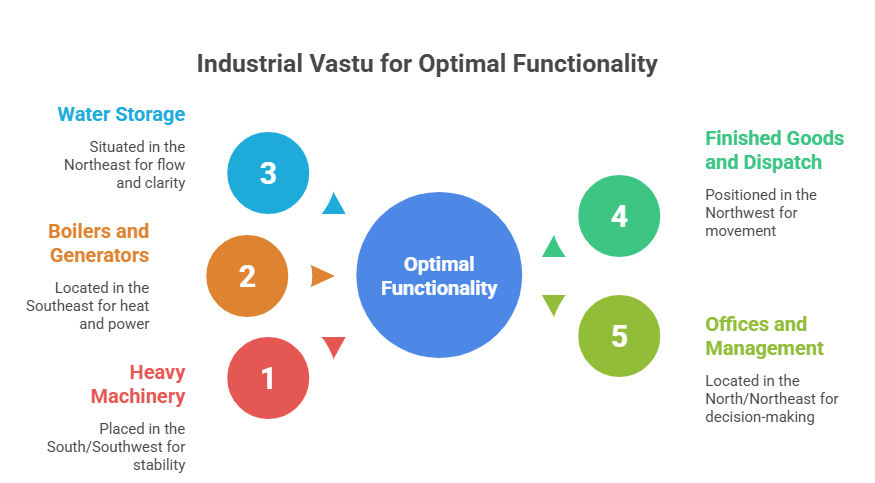
This is where Industrial Vastu gets very practical. Each direction carries a specific elemental quality, and placing the right activity in the right zone makes a real difference:
- Heavy Machinery goes in the South or Southwest, the Earth zone, which is built for weight and stability
- Boilers, Generators and Transformers belong in the Southeast, the fire zone, which suits anything related to heat and power
- Water Storage like borewells and tanks should sit in the Northeast, which governs flow and clarity
- Finished Goods and Dispatch work best in the Northwest, a zone associated with movement and outward energy
- Offices and Management Areas do well in the North or Northeast, where decision-making tends to feel clearer and more grounded
The Factory Shed Itself
Inside your production shed, the single most important thing is keeping the centre open. This central space, called the Brahmasthan, should never be blocked by heavy pillars, machines, or storage. When it’s clear, energy moves freely through the entire facility. When it’s blocked, you often see a kind of slowness or friction that’s hard to put your finger on.
The shed’s floor and roof should slope toward the North or East. And if workers can face North or East while at their stations, you’ll likely notice a difference in their focus and comfort over time. It sounds subtle, but it adds up.
How Geosols Can Help
We don’t come in with a long list of changes that require tearing things apart. Our approach at Geosols starts with a proper on-site visit where we look at your existing layout, identify specific problem areas, and suggest corrections that are practical and realistic.
We work with factories in and around Bahadurgarh, Barhi, and other industrial areas across Pan India. Our goal is always to help you get more out of what you already have, with changes that make sense on the ground.
If your factory has been underperforming despite your best efforts, it might be worth taking a closer look at the space itself. Get in touch with Geosols today and let’s have an honest conversation about what a Vastu assessment can do for your unit.