Why Vastu for Roof Is Essential for a Balanced and Positive Home
Most people spend a lot of time thinking about their interiors, furniture, and wall colours when it comes to Vastu. But here is something many homeowners overlook completely: the roof. In Vastu Shastra, the roof is not just a protective cover over your head. It represents protection, cosmic energy, and the overall prosperity of everyone living under it.
Vastu for Roof: Get the roof right, and positive energy flows freely into your home. Get it wrong, and you may never quite figure out why things feel slightly off, no matter how well-decorated the inside is.
Why the Roof Matters More Than You Think
Think of the roof as the point where your home connects with the universe above. The direction your roof slopes, how high your ceiling is, and where your water tank sits are all factors that quietly shape the energy inside your home every single day.
In Vastu, water symbolises wealth and flow. So the direction in which rainwater drains off your roof is essentially the direction your prosperity moves. That is why the roof slope is taken very seriously in Vastu Shastra.
Best Direction for Roof Slope
This is the most important roof Vastu principle. The slope of your roof should always guide water towards the more auspicious directions.
| Slope Direction | Vastu Effect |
| Northeast ✅ | Most auspicious, combines wealth and health energy |
| North ✅ | Promotes financial stability and mental peace |
| East ✅ | Supports health, spiritual growth, and new beginnings |
| South ❌ | Stagnant energy leads to health and financial challenges |
| West ❌ | Creates heaviness and financial blockages |
| Southwest ❌ | Most negative direction, best avoided completely |
The ideal setup is a roof that is highest in the Southwest and lowest in the Northeast, so rainwater naturally flows towards the North or East. This simple arrangement alone can have a significant positive impact on the health and financial stability of the household.
What About the Slope Angle?
You do not need a dramatically steep roof to follow Vastu. In fact, a very steep slope is not recommended. A gentle, gradual slope of up to 30 degrees is considered ideal because it allows energy to release steadily rather than rush away too quickly.
If you have a flat roof, do not worry. Even a slight tilt towards the North or Northeast is enough to align your home with Vastu principles. Small adjustments often make a big difference.
Terrace and Balcony Roof Rules
Many homes in India have a mix of terraces, balconies, and porticos attached to the main structure. Here is what Vastu says about them.
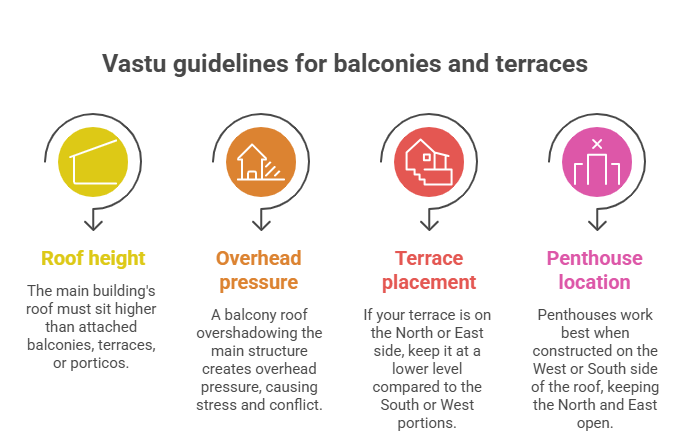
- The main building’s roof must always sit higher than any attached balcony, terrace, or portico
- When a balcony roof overshadows the main structure, it creates what Vastu experts call overhead pressure, which can show up as persistent stress, conflict, and a general sense of burden among family members
- If your terrace is on the North or East side, keep it at a lower level compared to the South or West portions
- Penthouses work best when constructed on the West or South side of the roof, keeping the North and East open and unobstructed
Where Should Your Water Tank Go?
This is one of the most common Vastu mistakes homeowners make without realising it.
- Place the overhead water tank in the South, West, or Southwest zone of your roof
- Placing it in the Northeast is a significant Vastu defect. This zone governs clarity, health, and abundance, and a heavy water tank here can suppress all of these
- Make sure the tank has no leaks or seepage, as water dripping from above is considered one of the more serious Vastu concerns in any home
- If you have a rainwater harvesting system, directing the collection pit towards the Northeast is both Vastu-friendly and eco-conscious
Ceiling Height: The Floor-by-Floor Rule
Many people do not realise that ceiling height also falls under Vastu guidelines.
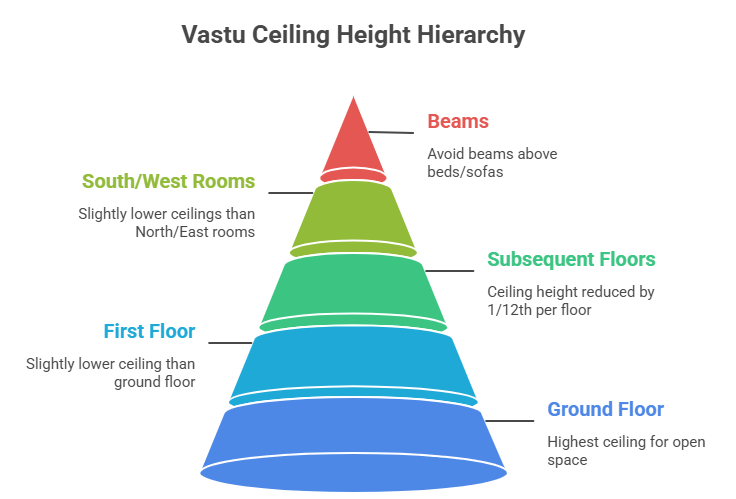
- Your ground-floor ceiling should always be higher than the ceiling on the first floor
- As a general rule, reduce the ceiling height by approximately 1/12th with each floor you go higher
- Rooms on the South and West sides can have slightly lower ceilings than rooms on the North and East sides
- One thing to watch out for: beams running directly above your bed or sofa. This is a very common Vastu defect and is associated with pressure, fatigue, and disrupted sleep
Choosing the Right Roofing Material
The material your roof is made of also plays a role in Vastu compliance.
- Clay tiles and terracotta work particularly well for North and East-facing slopes as they strengthen the Earth element
- Light-coloured or reflective finishes help amplify the positive energy on East-facing surfaces
- Heavy, unventilated concrete on the South or West portions without proper airflow tends to trap stagnant energy over time
- Stay away from sharp or pointed decorative structures on the rooftop as they invite harsh and aggressive energy into the space
What to Keep and What to Avoid on Your Rooftop
✅ Perfectly fine to have:
- Water tank placed in the Southwest zone
- A small terrace garden on the North or East side
- Wind chimes near the Northeast corner
- Solar panels (best to consult a Vastu expert for the right direction)
❌ Best to remove or avoid:
- Garbage, broken furniture, or old electronics
- Sharp or pointed decorative elements
- Uneven or asymmetrical additions to the roof
- Cluttered or unused penthouse spaces that block energy flow
Roof Slope Is Wrong. Do You Need to Break It Down?
Absolutely not. This is one of the most reassuring things about modern Vastu consulting. If your roof slopes the wrong way, there are practical remedies that work without any demolition.
- Install gutters and downspouts that redirect water flow towards the North or East
- Place a Vastu pyramid or crystal on the roof to neutralise directional energy imbalances
- For a Southwest-low slope, dig a small pit or trench on the Northeast side to replicate the correct drainage pattern
- Apply Vastu-corrective colours like white or light green on South and West parapet walls to balance heavy energy
The Geosols Way
At Geosols, we believe that your home does not need to be torn apart to be fixed. Our roof Vastu assessments identify every slope issue, water tank placement error, ceiling imbalance, and overhead defect with precision. And every solution we suggest is practical, cost-effective, and completely free of demolition because a harmonious home should never come at the cost of disrupting the one you already have.